
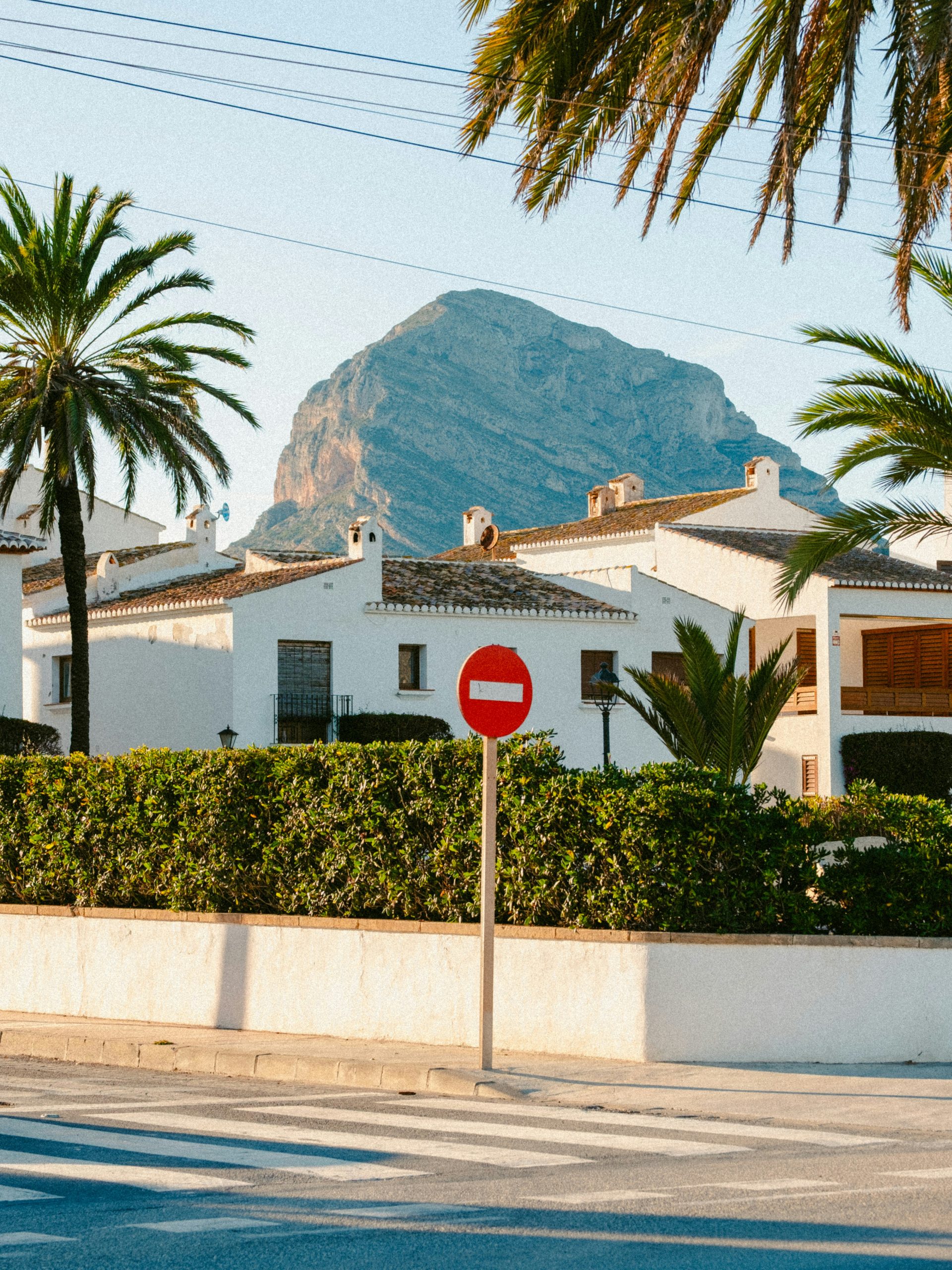
What seasonal tourism changes about the way we use streets, pavements and buildings in the Marina Alta.
There are two versions of almost every coastal town in the Marina Alta.
One appears in January. You can usually find somewhere to park, the pavements have room for two people to pass and the café owner has time to finish a conversation. The other arrives in August, when a journey that took five minutes in winter can become an exercise in patience.
The buildings haven’t moved. The roads are the same width. Even the benches are in exactly the same places.
But the town works differently.
And perhaps the interesting question isn’t how many more people arrive in summer. It’s how much extra work the town asks everyone to do when they get here.
A pavement designed for February
Take an ordinary pavement in Jávea. Not a particularly bad one. Just a stretch with a few café tables, a tree, perhaps a motorcycle parked slightly too close to the kerb.
In January, it probably works perfectly well.
Someone walking a dog passes a couple heading towards the shops. A delivery driver stops briefly. Nobody needs to think very hard about getting through.
In August, the same pavement has to accommodate families with pushchairs, people pulling beach bags, restaurant customers studying menus and visitors who have stopped to look at their phones.
A pavement that was perfectly adequate for the winter population becomes a series of small negotiations.
Who moves first? Does the person with the pushchair step into the road? Can two people carrying shopping pass without one having to stop?
None of this necessarily produces an accident or a formal complaint.
It just makes walking more tiring.
That’s an important distinction. A street can remain technically accessible while becoming noticeably less pleasant to use.
The five-minute journey that isn’t
Summer congestion is usually discussed in terms of traffic. Roads become busy, parking becomes difficult and journeys take longer.
But pedestrians experience their own version of congestion.
Consider a short journey from a residential street to a supermarket. In January, the route might involve two crossings and a straightforward walk along the pavement.
In August, there may be people waiting outside restaurants, vehicles stopping to unload luggage and more pedestrians trying to cross at the same time.
The distance hasn’t changed. The number of interruptions has.
This is something worth measuring rather than simply complaining about.
The site’s earlier four-minute crossing test shows how a crossing that should take seconds can become a much longer interruption when pedestrians have to negotiate two sets of traffic lights.
A similar test in January and August could reveal something useful about seasonal pedestrian movement.
Not simply how long the journey takes, but where the extra time disappears.
Shade becomes a form of infrastructure
There’s another complication in August.
Heat.
A bench that looks inviting on a sunny January afternoon may be almost unusable at two o’clock in August. A bus stop that provides an acceptable wait in winter can become an uncomfortable place to stand in summer.
The problem isn’t necessarily the absence of seating or public transport. It’s that the facilities aren’t equally useful throughout the year.
The site’s five-minute bus stop test describes passengers avoiding the actual stop because the only useful shade falls several metres away.
The bench-gap study raises a related problem: having somewhere to sit is not the same as having somewhere useful to rest.
Seasonal comparisons would add another dimension.
Does the same bench receive shade in January and August? Does a nearby building cast enough shadow to make waiting tolerable? Is there somewhere to sit within a reasonable distance of the shops?
A town doesn’t need to install expensive new structures everywhere.
Sometimes the answer might be a tree, a different bench position or a small adjustment to an existing shelter.
But somebody has to notice the problem first.
Buildings have seasons too
The seasonal difference doesn’t stop at the front door.
In winter, a south-facing apartment may feel wonderfully bright. The sunshine reaches deep into the living room and opening the curtains is one of the pleasures of the day.
In August, that same room may receive more heat than its occupants want.
Windows that provide welcome winter sunshine can also admit unwanted summer solar gain. The result depends on their orientation, glazing, external shading and the way the building is ventilated.
Older coastal properties introduce other complications. Some have windows that no longer close properly, shutters that have become difficult to operate or sliding doors that struggle after years of exposure to salt air.
These aren’t particularly glamorous urban-planning issues. But they influence whether a home is comfortable during the busiest and hottest part of the year.
Local window specialists such as Jávea Windows deal with these practical questions when assessing older glazing and replacement windows in coastal properties. The appropriate solution may involve different glass, better seals or a change to the opening arrangement rather than simply replacing everything.
There’s an interesting connection here between the private building and the public street.
Both may function adequately for much of the year, yet struggle under summer conditions.
And in both cases, small physical details can have a disproportionate effect on comfort.
The winter town hasn’t disappeared
It’s easy to describe August as the problem and January as the ideal.
That would be unfair.
Summer visitors support businesses that might otherwise struggle. Restaurants fill their tables, shops enjoy greater footfall and holiday accommodation brings money into the local economy.
The seasonal population is part of the character of the Costa Blanca.
But a town also has permanent residents who need to get to the pharmacy, catch a bus, visit the health centre or simply walk home with their shopping.
Their everyday journeys don’t disappear when the holiday season begins.
For an older resident, a crowded pavement can be more than a minor inconvenience. For someone using a walking aid, the loss of a clear route may determine whether a journey is practical at all.
The earlier pharmacy-run observation makes a useful point about ordinary journeys: what looks straightforward on a map can involve a surprising number of obstacles when somebody actually has to complete it.
Summer adds pressure to many of those same small systems.
What would a proper seasonal test look like?
A useful comparison wouldn’t require an elaborate research project.
Choose one ordinary route in Jávea, Moraira or Dénia. Ideally somewhere used by residents throughout the year rather than a promenade visited mainly by tourists.
Walk it once in January and again in August.
Use the same starting point, destination and approximate time of day.
Record five things:
- Journey time. How long does the complete walk take?
- Obstructions. How often is it necessary to stop, change direction or leave the normal walking line?
- Crossing delays. How much time is spent waiting to cross roads?
- Resting places. Are benches available, occupied and shaded?
- Thermal comfort. Which sections offer shade and where is there no practical escape from direct sun?
Temperature, weather and unusual events should be recorded too. Otherwise, it’s easy to mistake the effect of a particularly hot day or a temporary road closure for a seasonal pattern.
One walk in each season wouldn’t establish a reliable town-wide trend. It would provide a starting point and identify locations worth checking again.
The important thing is to use the same method both times.
Without that, we’re left comparing memories rather than observations.
One small fix, not another masterplan
Suppose the comparison shows that one particular stretch of pavement becomes difficult to use every August.
The obvious response might be to call for a major redesign.
But perhaps the problem is more specific.
A badly positioned sign narrows the available space. A delivery vehicle regularly blocks the kerb. Café furniture extends too far into the walking route during busy periods.
Moving the sign, adjusting the loading arrangements or keeping a clear pedestrian corridor could improve the situation without rebuilding the street.
The same applies to shade.
If people consistently avoid a particular bench during summer afternoons, its location may be the problem rather than the number of benches.
This is the value of looking closely at ordinary places.
Large infrastructure projects attract attention. Small adjustments rarely do, even when they make daily life noticeably easier.
Two towns sharing the same streets
January and August reveal different things about a coastal town.
Winter shows how the streets function when demand is relatively low. Summer reveals what happens when those same streets are asked to accommodate more people, more movement and more heat.
Neither season tells the whole story.
A route that works in January isn’t necessarily well designed. It may simply have enough spare capacity to conceal its weaknesses.
And a street that struggles in August isn’t necessarily badly planned. It may need a handful of targeted improvements to cope with its busiest weeks.
The useful question is not whether Jávea should become more like its winter self.
It’s whether the town can remain comfortable, accessible and practical when August arrives.
The pavements are the same width in both months.
What changes is how much we ask of them.